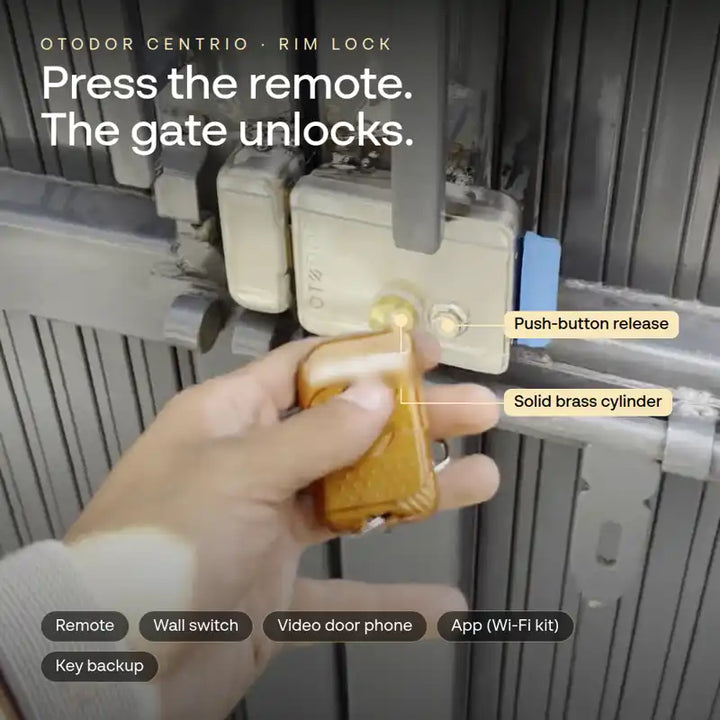

[ Swing Gate Opener ]
BLANCO
Smart gates. Seamless access.
Kits from ₹44,999 · Installed by OTODOR · 2-year warranty
[ The kit ]
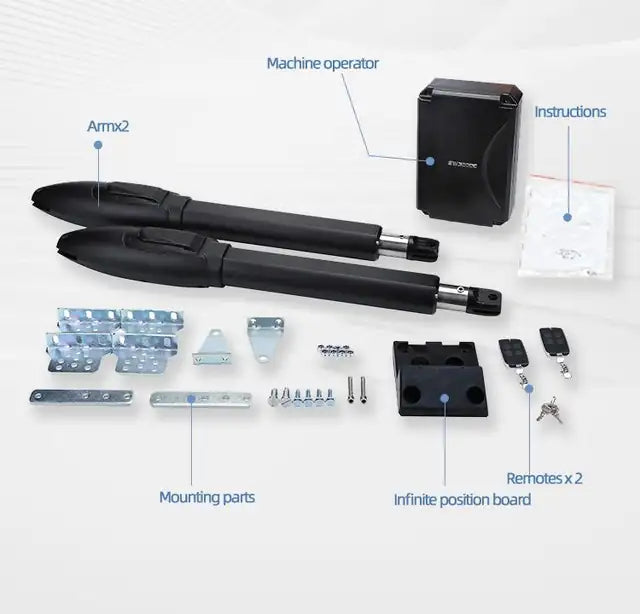
BLANCO for double-leaf swing gates.
Two screw-driven arms and one controller. Your gate opens from a remote, a push button, an access panel or — with the Wi-Fi module — your phone. Pick by the weight of one leaf.
Blanco ARM 300
Up to 300 kg per leaf · homes, villas, duplex driveways
Blanco ARM 400
Up to 400 kg per leaf · heavy MS, wrought iron, farmhouses
Installation ₹5,999 · prices include 18% GST · weight confirmed at a free site survey before dispatch.
In the box
- 2×Screw-driven arms with manual release key
- 1×Controller (machine operator) with digital display
- 2×4-button remotes (up to 32 can be paired)
- 1×Infinite position board
- 1×Mounting set — wall brackets, connecting brackets, M8×25 screws, M8 self-locking nuts
- 1×Instruction manual
[ What it does ]
Everything a two-leaf gate
should do on its own.
[ Safety ]
It touches.
It turns back.
Resistance bounce: the controller watches the motor load on every movement. The moment a closing leaf meets resistance, it reverses and opens again.
- Photo beams across the gateway stop the gate before it ever touches anything. Recommended for every home with children or pets.
- Warning lamp flashes before and while the leaves move.
- Single or double gate mode — set it for a one-leaf or two-leaf gate.
[ Pedestrian mode ]
One leaf for people.
Both for the car.
Separate control lets you open a single leaf from an external switch or a dedicated remote button — for the newspaper, the milkman or a quick walk out — without swinging the whole gate open.
[ Installation ]
How Blanco is fitted
to your gate.
Each arm mounts between a bracket on the pillar and a bracket on the gate leaf. It works for gates that open inwards or outwards — our technician sets the bracket position on site so each leaf opens a full 90°.
- Pillar bracket. A wall bracket and connecting bracket fix to the pillar with M8×25 screws and M8 self-locking nuts. The connecting bracket can be set in five different positions to suit your pillar.
- Dimensions A and B. The distance of the pillar bracket from the hinge sets how far the leaf opens. We measure your pillar and hinge and set A and B from the Blanco installation chart.
- Gate bracket. Welded or bolted to a strong member of the leaf, at the same height as the pillar bracket so the arm stays level.
- Limit stopper on the ground where the leaves meet when closed, and a safety stopper at the fully open position so a leaf can never over-swing.
- Wiring. 220V AC single-phase supply to the controller; a 2-core cable from the controller to each arm (24V DC). Leave a 1 m loop at each arm so the cable moves with the leaf.
[ Specifications ]
Tech specs.
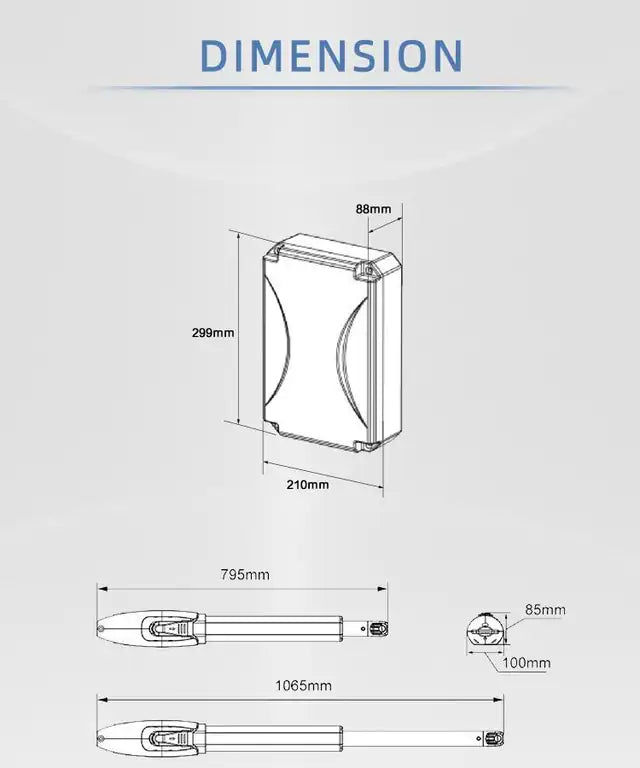
| Controller (H × W × D) | 299 × 210 × 88 mm |
| Arm length, retracted | 795 mm |
| Arm length, extended | 1065 mm |
| Arm section | 100 × 85 mm |
- Model
- OTODOR Blanco
- Power supply
- AC 220V / 50 Hz, single phase
- Motor
- DC 24V, 50W
- Maximum load
- 300 kg per leaf (Blanco ARM 300) · 400 kg per leaf (Blanco ARM 400)
- Maximum leaf length
- 3.0 m
- Driving method
- Screw-driven piston (linear actuator)
- Limit switch
- Electromechanical limit switch / hall sensor
- Gate speed
- 2.5 cm per second
- Auto-close
- Adjustable, 0–99 seconds
- Remotes
- 2 included · up to 32 · 433.92 MHz · range over 30 m
- Gate modes
- Single leaf or double leaf · pedestrian (one-leaf) mode
- Safety
- Anti-pinch resistance bounce · photo beam and safety beam inputs
- Interfaces
- Alarm lamp · photo beam · safety beam · access control
- Power failure
- Manual release key on each arm · optional 24V 4.5 Ah / 9 Ah backup battery
- Wi-Fi
- Optional Wi-Fi module for mobile-phone control
- Work duty
- S2, 30 min
- Working temperature
- −20 °C to +70 °C
- Warranty
- 2 years standard · 3 years with OTODOR Care+
- Country of origin
- China
Six reasons a two-leaf gate stops being worth pushing.
A swing gate is two gates. Every trip out means opening both and closing both, and one of them always gets left.
You never step out of the car
No getting out in the rain, in the heat, or at 11 pm on a dark road to push two gates open.
Both leaves, together, every time
No more one leaf left swinging open because someone was in a hurry.
Nobody walks in behind you
A manual gate stays open as long as someone leaves it open. An automatic gate closes itself.
The gate stops for a child
Photocell sensors watch the gateway. The moment something breaks the beam, the leaves stop and reverse.
Your hinges last longer
Slow start and slow stop mean far less stress on hinges and welds than two leaves being shoved and slammed.
It works when the power doesn't
A manual release on each arm. Open the gate by hand in seconds.
Two kits. Pick by the weight of one leaf.
Go by one leaf, not both together — a pair of 200 kg leaves is a 300 kg kit, not a 400 kg one. It is the single most common mistake customers make on swing gates, and our technician confirms the weight during the free site survey, before anything is dispatched.
Every Blanco ARM kit is complete — two arms, one controller and two remotes in the box, with an optional Wi-Fi module for phone control. Single-leaf and double-leaf modes, adjustable auto-close, obstacle detection, and a manual release on each arm for power cuts.
See the price for your gate.
Five short steps, three of them a single tap. No gear rack and nothing priced per metre — on a swing gate the total is complete the moment you pick your kit.
Choose your kit
Pick by the weight of one gate leaf, not both together. A pair of 200 kg leaves is a 300 kg kit, not a 400 kg one. If you are not sure of the weight, pick the closest and our technician will confirm it during the free site survey — before anything is dispatched.
How wide is one gate leaf?
Measure one leaf, from hinge to the far edge — not the full opening. On a two-leaf gate that is roughly half the opening. We ask because the arm has a fixed stroke and there is a limit to how wide a leaf it can push.
Every kit is complete: two arms, one controller and two remotes. Nothing else to buy for the gate to work — Wi-Fi phone control is an optional add-on.
Safety sensors
RecommendedA pair of infrared sensors fitted on your two pillars. They watch the gateway, and the moment a child, a pet or a vehicle breaks the beam the gate stops and reverses. On a swing gate the leaves move out towards you, so this matters even more than on a sliding gate.
Without sensors the gate has no way to detect anything in its path. You can still add them later, but the wiring is much easier to do now.
Warning light
A flashing light fitted on top of your pillar that comes on before and during gate movement, so anyone approaching knows the leaves are about to swing out. Optional. Most useful where the gate opens outwards onto a footpath or a public road.
OTODOR Care+
Your kit already carries a 2-year warranty as standard. Care+ adds a third year for a flat fee — no percentage, no fine print. Worth taking on gates that run many cycles a day: society gates, schools, factories and shared driveways.
Installation
₹5,999Certified welder for the arm brackets and stop blocks, OTODOR technician for mounting and commissioning, sensor alignment, travel setting, remote and app pairing, and an on-site demo before we leave. It costs more than a sliding installation because a swing gate needs stop blocks fixed and both arms aligned to two separate leaves — more welding, more setting.
Not included: civil work and pillar repair, gate fabrication or hinge replacement, and the electrical point — we will send you exactly what to keep ready.
Your price
You save against MRP
Indicative price. Confirmed after our free site survey. Prices are inclusive of 18% GST.
Installation includes one free demo visit. Site visits after 30 days from installation are chargeable.
What you need to keep ready before we arrive
Give this page to your electrician and your mason. Shorter than the sliding list — there is no gear rack and the controller can go where you want it — but the stop blocks are not optional.
01
Power supply point
- 220–240V AC, single phase, 50Hz. Three phase is not required.
- Your controller can go wherever you want it — inside the boundary wall, in the guard room, in a porch, or in a weatherproof box on the pillar. Tell us the spot during the site survey and we will plan the runs from there.
- 3-core copper cable to the controller — Phase, Neutral and Earth. 1.5 sq.mm is enough for the run in most homes.
- One dedicated 16A MCB plus a 30mA RCCB or RCBO in the main board. Label it GATE MOTOR.
- Earthing is mandatory. Independent earth continuity to the controller, resistance under 4 ohms.
02
Cable to the two arms
- Two 2-core runs — one from the controller to each gate leaf, for the two arms.
- Run each inside 20–25 mm PVC conduit, with a draw wire left in.
- Leave a 1 metre service loop at the arm end. The arm moves with the leaf, so the cable has to travel with it — the loop is not optional.
Blanco arms run on 24V DC from the controller, so one 2-core run to each arm is correct. We confirm cable sizes at the site survey before any cable is pulled.
03
Cable for the safety sensors
- Two outdoor-grade CAT-6 runs — one from the controller to each pillar.
- Straight line, inside conduit, sweep bends only, no sharp right angles.
- Terminate 500–600 mm above finished ground level, matched within 10 mm on both pillars. If the two heights differ, the beams will not align.
- 300 mm service loop at both ends.
04
Cable for the warning light (only if taking one)
- One run from the controller to the top of the pillar, on the side facing traffic.
- DC 12V or 24V strobe: CAT-6 is sufficient.
- AC 220V strobe: 3-core 1.5 sq.mm instead. CAT-6 is not rated for mains voltage.
Confirm which version you are taking before your electrician pulls the cable.
05
Civil work checklist
- STOPPERS MUST BE IN PLACE. Fix a limit stopper where the leaves meet when closed and a safety stopper at the fully open position of each leaf before we arrive, so the gate can be set up and commissioned on the day.
- Both leaves must swing freely by hand, end to end, with no dragging and no lifting. Hinges seized or sagging must be repaired first.
- Pillars must be solid enough to carry an arm bracket. A cracked or hollow pillar face needs repair before installation.
- Enough clear space behind each leaf for the arm to fold back at the fully open position.
- Power and data conduits kept separate. Never pull CAT-6 and 220V through the same pipe.
- Buried conduit: 450 mm minimum under driveways with warning tape above it, 300 mm elsewhere.
Stop blocks are the one item on this list that stops an installation dead. If they are not in the ground on the day, the arms can be mounted but the gate cannot be set up — and we have to come back.
Not sure what your site needs? Send us a photo of your gate and we will tell you exactly what to keep ready.
Ask an OTODOR expertSwing gate motor installation in Delhi NCR and North India
We install directly across Delhi, Noida, Greater Noida, Gurugram, Faridabad, Ghaziabad and Sonipat. Across the rest of North India — Chandigarh, Punjab, Haryana, Rajasthan, Uttar Pradesh and Uttarakhand — we supply and coordinate installation through the OTODOR partner network.
Sixteen years in gate automation means the gates we automated in 2010 still have parts available today. That is the difference between a brand and an importer.
Free site survey before anything is dispatched.
Guides